Showing posts with label Outsider Art. Show all posts

Monday, October 15, 2012

Return to the Future Past . . .

.
.
.
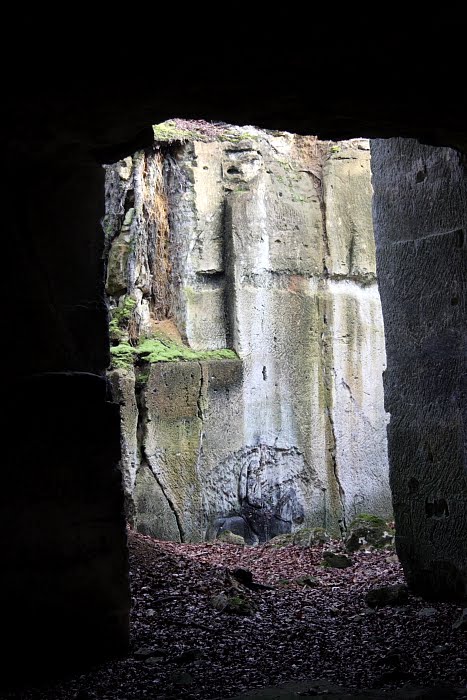
Here are a few more photos from the same site that the photo currently entered in a contest was taken at (see below post, and please vote), out in a stretch of woods in northern France that not many people ever visit, where there are dozens of large sculptures carved in the stone of an old quarry, which date from the First World War. You can also see more pictures of this site here. Sadly, this little known site is out in a remote forest, exposed to the weather, and the magnificent artwork here is slowly but surely disappearing. I'm going back there tomorrow to make another series of photos to help document what's left. Wish you could come...
.
.
.
.
.
.
.
.
.
.
.
.
.
.
.
.
.
.
.
.
.
.
.
.
.
.
.
.
.
.
.
.
.
.
.
.
.
.
.
.
.
.
.
.
.
.
.
.
.
.
.
.
.
.
.
.
.
.
.
.
.
.
.
.
.
.
.
.
.
.
.
.
.
.
.
.
.
.
.
.
.
.
.
.
.
.
.
.
.
.
.
.

Friday, February 18, 2011

A Winter Walk In the Woods of the Past . . .

.
.
.
As you may have realized by now, if you've been keeping up with these pages for any length of time, one of my areas of interest is the history of World War One, and especially the surviving artwork associated with that awful conflict. One branch of that domain is the poetry which emerged from those war years, particularly that of Robert William Service, a Scot turned Canadian who served as an ambulance driver during the war, and who wrote a volume of poetry titled Rhymes of a Red Cross Man, which in my humble opinion is nothing short of excellent. Good reading for long winter nights.
.
Another branch on the tree of subjects related to WWI artwork is the sculpture and graffiti left behind by troops in various places, often on the walls of stone quarries which served as troop shelters. Quite some time ago, before anyone had even started visiting this obscure blog, I wrote a couple of posts about a gentleman named Jean Cartier who created two fabulous books about the remaining visible traces of WWI. Over a span of roughly 8 years and 30000 kilometres traveled, he visited and photographed hundreds of sites in Belgium and France where traces of WWI are still visible. You can see some of Jean Cartier's work on his website.
.
It was largely thanks to Jean Cartier's books that la Grenouille and I set out yesterday to find one of the sites documented in those volumes. The location of his photographs was not divulged in the book; it took quite a bit of research, some questioning of local residents, and some hiking in the woods before a leafy path curving up a hill finally led us to the place we were looking for.
.
.


.
.
On arriving at the quarry site, one is greeted by a large stone sphynx's face. We wondered if the nose had been broken off in order to echo the famous sphynx at Gizeh which also lost it's nose at some point in history. This sphynx was carved in the rock by a sculptor named Cadars in 1915. Despite the disfiguration of missing nose, and some idiot's initials or name carved in the face, it still stands enigmatic, powerful, mysterious in the forest, inspiring considerable awe.
.
.


.
.
Venturing further into the old quarry, from a distance there is a work which almost resembles a bear, in the ancient tradition of cave decorations done by pre-historic man.
.
.


.
.
Drawing closer, it is in fact a mounted military rider, the part that looked like a bear from a distance is the rock that had to be removed to give relief to the sculpture. I'm wondering if the bear image was just a coincidental result. The horse is wading through last autumn's leaves.
.
.

.
.
Another horseman, sadly with broken legs, graces a surface. Apparently (according to one site) this is a depiction of Marechal Joffre, who commanded the French forces from 1914 to 1917.
.
.


.
.
Rounding another corner one comes face to face with a large sculpture representing Joan of Arc, also missing her nose. A powerful figure nevertheless. As we visited the site our exclamations of astonishment rang out frequently, it is simply one surprise after another; simply amazing that a site overflowing with such wonderful art is far out in the woods, abandoned to the ravages of weather and vandals. This work deserves to be protected for posterity. IMHO a temple of sorts should be built around and over it to protect it. With guardians.
.
.


.
.
Troops during the war lived in dreadful conditions, and probably thought often and longingly of women. This pair of parisian ladies are similar to what might have been seen in fashion magazines of the period. They compose one of the loveliest bas relief sculptures I've ever seen anywhere.
.
.


.
.
Under the daintily pointed foot the inscription says, "Zut, voilà qu'il pleut"... "Drat, it's starting to rain !"
.
.

.
.
Another lovely goddess has bunches of grapes in her hair ; symbolizing a longing for wine, women, and song ? The inscription by her bared breast says 1916. I couldn't help falling a little in love with her.
.
.


.
.
In one of the quarry caverns an altar for religious services was carved in the wall, flanked by memorials to people who may have perished there or nearby. Such quarries were often used for medical posts. In the woods above the quarry there is a cemetery. Some of the people named here may be buried there. Unfortunately tombstones from the cemetery have been stolen by unscrupulous thieves. This simple place of worship was quite sobering and humbling.
.
.

.
.
The author of the sphynx also sculpted this "Croix de Guerre", a French military decoration for bravery.
.
.


.
.
The below sign was hanging near the Joan of Arc sculpture, stating that anyone removing anything from the site or causing any damage could be subject to being imprisoned.
.
.

.
.
I wondered if the act of dragging and abandoning an automobile in such a place would qualify the guilty party for a few months or years in jail ? What do you think ?
.
.

.
.
.

Friday, June 18, 2010

Wirwignes : A Decorated Church . . .

.
.
Just a couple of weeks ago Henk van Es, in Holland, who has created an excellent blog about outsider art sites around Europe, did a post about a church in northern France in the village of Wirwignes which had been intricately decorated by the parish priest, Paul-André Lecoutre from 1867 through his death in 1906. Henk's post about the church is here.
.
As with many of the sites that Henk researches and writes about, I was considerably intrigued and desired to see the real thing, to find out what such a site might look like today. Checking the map, I realized that Wirwignes is just to the east of Boulogne-sur-Mer on the coast of the English Channel. As I had another mission I'd been meaning to accomplish in that immediate vicinity for some time, I realized that with a day trip two birds could be killed with one stone, if you will pardon that violent expression. The other mission was to find the grave of the ancestor of a friend in the WWI military cemetery at Etaples, which is just south of Boulogne.
.
So I set out with a picnic lunch, and after visiting the military cemetery in Etaples, was in Wirwignes by mid-afternoon. The church was locked up tight, but a very nice lady in the town hall was willing to provide the key in return for my identity card. So I had the church all to myself that afternoon, and was able to discover first hand what had interested Henk enough to inspire his post about it. It was darker than I expected inside the church, and I was not properly equipped with tripod and external flash, so I had to make do with what little natural light there was, and the built in flash unit, which is a bit harsh and unforgiving at times. Hopefully the following photos will provide at least a small idea of what Father Lecoutre accomplished.
.
Many thanks to you Henk, if you had not written about this unusual site, I probably would never have gone there.
.
This first was on a wall in the village near the church, a type of sign one doesn't see many of in France any more, showing the two neighboring villages to Wirwignes and their distance.
.
.


.
The exterior of the church, they obviously have a creative gardener even today . . .
.


.
Apparently external chapels were added along the sides of the church by Father Lecoutre to accomodate his artwork . . .
.


.
The WWI memorial outside the church, invoking God to protect France . . .
.


Inside . . .
.


.
.


.
.


.
.


.
.


.
.


.
.


.
.


.
.


.
.


.
There were some signs of wear and tear in places . . .
.


A mosaic in the floor near the altar . . .
.


.
.
.

Sunday, November 1, 2009

Odds & Ends . . . (very odd !)

There are just a few things I wanted to say, which is to say, there are so many things I want to say, I hardly know where to start . . . so please bear with me if this post is a bit disjointed . . .
.
A kind commenting reader voiced mild surprise the other day that I was only just now getting around to posting some photos I'd taken back in August. But the reality of the situation is, there are hundreds of photos taken back in August that I hope to be posting sooner or later in these pages, as well as many since then, and even more from before last August, not to mention the thousands of black and white negatives which are still slowly making their way through the waiting line at the lab to become digital files . . .
.
So, where to start ? Perhaps with a reference to a post which was just re-posted a few days ago at Where's My Effing Pony, on the giddy subject of outhouses, or more precisely, porta-potties, and specifically, the dangers of having one fall over with you in it. I think it is safe to say that it requires a writer of some talent to bring such a subject to life and infuse it with hilarity; I will let you judge for yourself by going over there and reading the post for yourself. But I'd like to toss out, that between the post just referred to, and another at Not Waving but Drowning, there was quite a little discussion going there for a while as to whether or not there are any public toilets whatsoever in France, and if so, have they been cleaned any time recently ? So I present this photo taken yesterday in the town of Albert as proof that YES, there are public toilets in France. It is true that they are not always easy to find, but it is just not fair or balanced reporting to state that there are none. There are some, and I have found them. Much to my considerable. . . relief . . .
.


x


x


x


x


x


x


x


x


x

Now, having cleared that matter up definitively I think, let's get on to the next subject in this ramble. For some reason, both the Sagittarian at More Canterbury Tales, and Jeff at Life Is Beautiful, have been going on about massages recently. Now, along with public facilities, it is important to be able to find a good massage should one need one urgently . . . so in case anyone was wondering, there are massage parlors in France, as this photo from Paris attests . . .
.


x
And also on Life Is Beautiful, Jeff just posted a day or two ago a lovely photograph of a spider web, tying it into the notion of dreaming. To echo that, I'd just like to submit my own spider web photo taken a few weeks ago near the Bay of the Somme River . . .
.


x


This next one may in fact summarize quite neatly all of my early conceptions of France . . . as a place where poodles were groomed with surprising sophistication. And yesterday, at long last, after years of searching I finally found an image to symbolize that early (no doubt cliché-ed) conception ! I was giggling so hard I could hardly focus my camera . . . thank goodness for auto-focus lens mechanisms ! (My early conceptions of France obviously evolved over time to more subtle ideological representations, with the necessary passage via Frank Zappa's song "In France", which expanded my understanding considerably. If you can't quite make out the lyrics in this YouTube version, Google the lyrics separately, they are priceless, and also mention the famous french poodle, so I was not the only one who had poodles linked to their perception of France !)
.


x


x


x


x


x
This view puts the sign in perspective, it was not far from the central church in the town of Albert, which you will recall was at the heart of the Somme battlefield region in World War I. Albert was taken by the Germans in March 1918, only to be recaptured by the English & Australians & New Zealanders later that Summer. The church seen here was heavily damaged in the shelling of Albert.
.


x

And to conclude this disjointed little rambunctious ramble (well, I warned you), is this photo which I considered posting separately under a (borrowed) title like "Weird Scenes From the Gold Mines". I will let you decide what you think is going on here and share your conclusions in the comment box . . .
.


x
.
.

Thursday, June 4, 2009

Off the Wall ! (and On the Road. . .)

In any given day, probably only a relatively small number of people walk down the quiet back streets in Paris where I stumbled on these images the other day, when not looking for anything in particular. So I decided it was time for the three works of urban art shown here to come down off their walls and go on the road, to get out to see the world, and to be seen . . . by all of YOU good people. I have to admit, the second and third photo here made me think immediately of Theo Ellsworth's illustrations which you can see at Thought Cloud Factory News. His drawings are plenty of fun. (And sorry, no bikinis this time !)
.


.


.


.
.

Saturday, May 30, 2009

Totems . . .

Native Americans in the Pacific Northwest created totem poles, mysteriously magnificent homage to the natural world around them. Today we create other forms of totems. This totem in New Jersey, on Route 40, photographed in 1987 was prime black and white photo material. What do you make of it ? To honor what deity was this totem built ?
.


.
.